

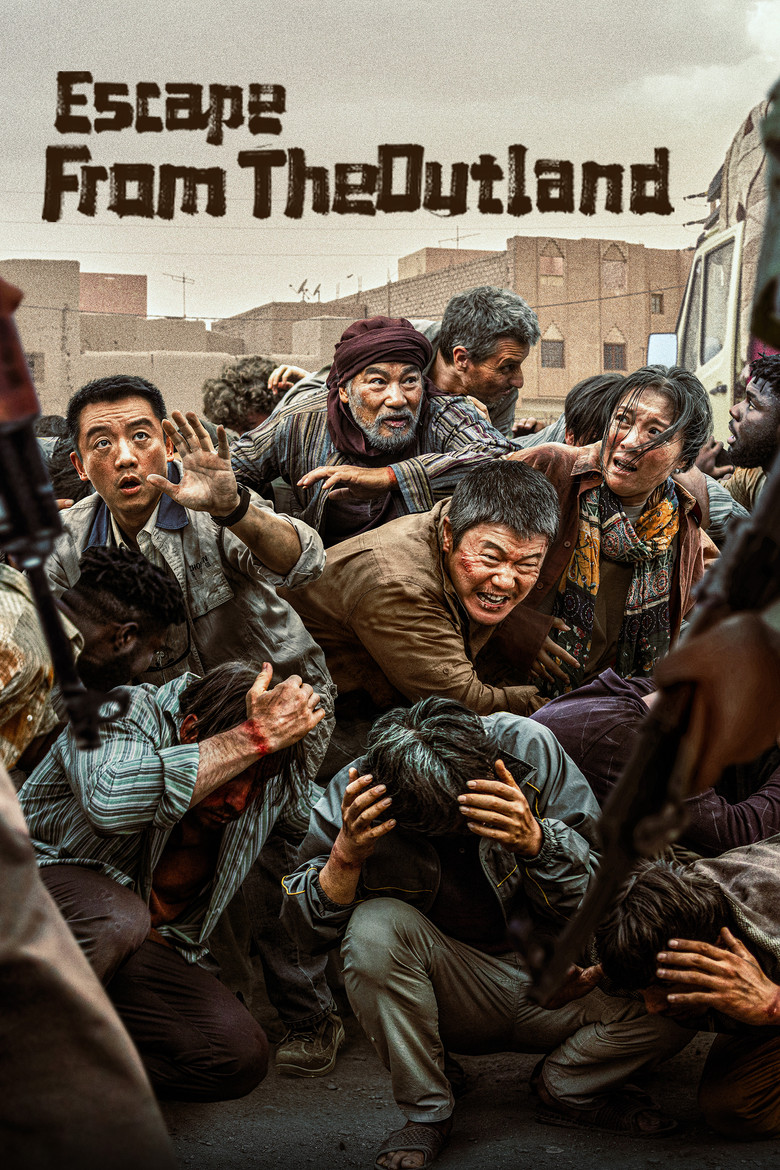
Escape from the Outland
The couple of Ma Xiao, a foreign correspondent, and Pan Wenjia, a volunteer doctor, accompanied engineer Miao Feng on a trip to the suburbs to repair a base station. During the trip, the local situation suddenly changed and the three were kidnapped by an extremist organisation. While in prison, they met Zhou Weijie, an overseas Chinese businessman. In order to find a chance of survival, they embarked on a journey of escape in the midst of barbaric warfare and chaos.

CinemaSerf@Geronimo1967
If they’d just left this as an action adventure film, then it might been better as no effort has been spared on the production standards. The snag is, though, right from the start it has an uncomfortable propagandist element to it. It’s all about an Arab and an African nation who have been sparring for generations until a decade ago when a semblance of truce broke out. Now, there’s been some mischief instigated by the “West” that’s leading to carnage. Caught up in all of this are pregnant doctor “Pan Wenjia” (Xi Qi) and her photo-obsessed journalist husband “Ma Xiao” (Yang Xiao) who quickly, separately, find themselves captured by the unscrupulous “Iron Army” who require her to treat their wounded and him to make videos of his fellow captives for whom they wanted $5 millions a head. Luckily, on his travels he encounters the local villager “Latif” (Fathi Anouar Ghammam) - after a distinctly ropey start, and then street-smart “Zhou Weijie” (Simon Yam) who might give them a fighting chance of escaping and making it to a nearby phone mast where perhaps they can contact their embassy who have been moving heaven and earth to rescue them from a modern day slavery, or the same grizzly fate that we see befall a few French soldiers - think poor old Brian Cox in “Ironclad” (2011). The acting really isn’t up to much, indeed I found Ma Xiao’s character really quite selfish and annoying. The plot is quite contrived and the action is a bit repetitious but we do get a sense of just how inhumane heavily armed fanatics can be when fuelled by zealousness and some of that does ring true especially when illustrating the weaponisation of children. The dialogue though, is pretty banal. There’s a scene where we are reminded that unlike previous colonists, the Chinese are only in these countries to build schools, hospitals and railroads - but that they take nothing. Hmmm!? It has a few goes at concluding before we finally cross a finish line which does drag it out a bit and in the end I was really quite disappointed with this over-long feature.
Darfell@Darfell
Yong Wu zhi Di cuts through survival-thriller tropes to deliver a searing anti-war punch, all centered on the unforgettable figure of Latif. A former teacher turned reluctant abductor, he is defined by quiet grief—for the loss of his son Sealim—and a bitter conviction that “war only feeds flies, not winners.”
When his captives’ escape leaves journalist Ma Xiao stranded, Latif’s slow pivot from captor to savior is the film’s heart: guilt softens into trust, and his mission to rescue Ma Xiao and his companions from the Iron Army becomes a redemptive stand against senseless violence. The scene of Salim falling dead behind the running car driven by his father Latif and the Chinese citizen shatters viewers, leaving them tearful and speechless long after the frame fades. Even with its unflinching brutal scenes, the film’s greatest power lies in these moments of raw, tender sensitivity—they resonate far deeper than any act of violence, anchoring the story in a quiet, unshakable humanity that lingers with audiences.